Related Articles

A little kitchen may seem like a riddle. Cooking a basic meal may become a game of shuffling pots and plates, the cabinets fill up too quickly, and there never seems to be enough counter space. Many believe that an expensive remodel that adds square footage or demolishes walls is the only solution. In actuality, with careful planning, creative storage, and a few reasonably priced improvements, the majority of small kitchens can be completely transformed. Because every square inch serves a purpose, some of the world’s greatest kitchens are incredibly small but still function flawlessly.
This manual is intended for novices who seek useful suggestions without requiring a lot of money or specialised knowledge. You will discover how to evaluate your area, organise, clear, add storage, enhance lighting, select colours, upgrade important functions, and maintain seamless operation. You’ll be shocked at how much your kitchen can alter if you take things one step at a time.
To begin, consider how you use your kitchen.
Spend a week observing how you really use the space before making any purchases or moving anything. Take note of where you put groceries, where you cook, and which cupboards you open most frequently. Take note of your frustrations. Perhaps the sole area for cutting is too close to the stove, or the garbage can obstructs the oven door. Maybe you buy duplicates because you can’t see what you already have because the pantry is so full.
Jot down these observations on your phone or in a notebook. You can use this straightforward record as a reference to determine what has to be fixed first. When adjustments address actual issues rather than merely following trends, a kitchen improves more quickly.
Measuring your space is also beneficial. Take note of the size of any empty wall spaces, the breadth of your counters, the height of your cabinets, and the separation between the refrigerator, stove, and sink. These figures will help you plan storage and prevent you from purchasing products that don’t fit.
Before you do anything else, declutter.
Eliminating unnecessary items from a tiny kitchen is the most economical approach to make it better. Because every extraneous object takes up space that could be used, clutter is the biggest threat to tiny areas. Sort everything into three categories: keep, donate, and dispose. Start by removing everything from one area at a time, such as a single cabinet or drawer.
Be truthful with yourself. Do you really need a drawer full of mismatched plastic containers, three can openers, or five spatulas? Items you haven’t used in a year, damaged electronics, outdated food, and duplicate equipment can typically be discarded. Large-space-consuming speciality appliances, such bread makers or infrequently used juicers, can be better off being stored somewhere else or given to someone who will use them.
Make sure your countertops are clear. Only items that you use practically every day, such a cutting board or coffee machine, should be kept on a counter. The rest can be moved onto walls or into cupboards. Clean, open counters provide you the work area you need for cooking and give the impression that a kitchen is larger.
Arrange What’s Left
Organization transforms your remaining stuff into a simple structure once the clutter has been removed. Put comparable items in one group. Keep plates and glasses near the dishwasher or sink, baking supplies in one location and cooking oils and spices close to the stove. Cooking goes more smoothly and cleaning is quicker when everything has a logical place.
To get the most out of drawers, use organisers and dividers. A divider for pots and pan lids keeps things organised, while a basic tray keeps utensils tidy. Stackable containers make effective use of vertical space, and clear containers for dry products like rice, pasta, and flour allow you to quickly see what you have. All members of the household can return goods to their proper location with the use of labels, even those that are handwritten.
Consider how often you utilise it. Store occasional items on higher or lower shelves, and arrange the products you reach for on a daily basis at waist or eye level. Holiday platters and other infrequently used goods can be stored outside the kitchen or on the top shelf.
Utilise Vertical and Hidden Space to Increase Storage
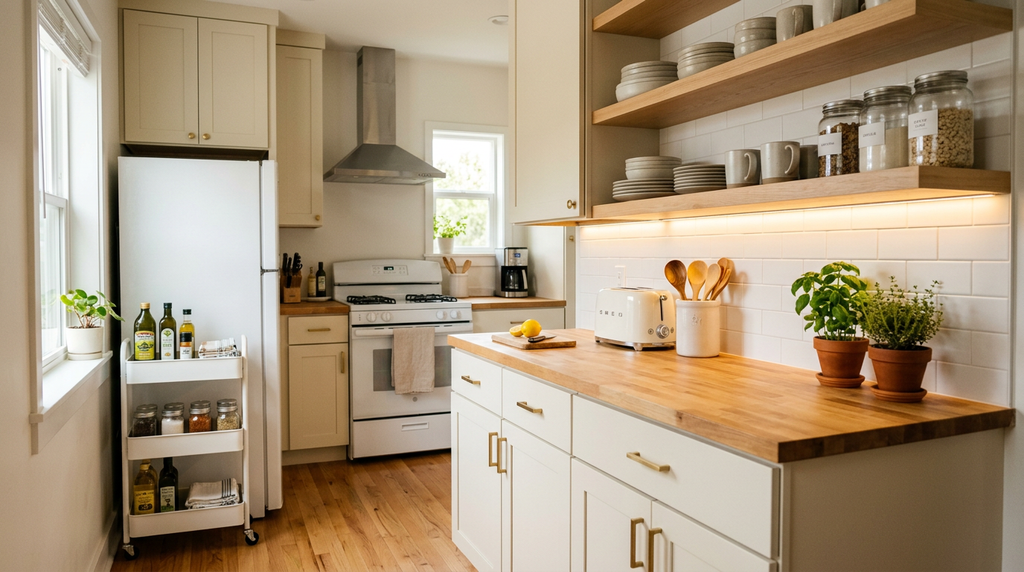
Building higher and utilising areas you might not have thought of is the solution when floor and counter space are limited. One of the greatest tools for a small kitchen is a wall. Install open shelves for jars, glasses, and plates to keep commonly used goods accessible and lighten the space. Knives may be stored on a wall-mounted magnetic strip, while utensils, pots, and mugs can be stored on a rail with hooks.
Examine the interior of cabinet doors. Cutting boards, measuring cups, pot lids, and cleaning materials can be stored on the small racks or hooks that are affixed there. Under-shelf baskets double the amount of usable space inside cabinets by adding an additional level. Deep cabinet pull-out organisers make it simple to access goods at the rear without having to dig.
The area above the cabinets should not be disregarded. It is ideal for keeping baskets filled with sporadically used objects. A thin rolling cart or magnetic racks for spices can be placed on the refrigerator’s side. An over-the-door organiser containing cleaning supplies, foil, or snacks can even be supported by the rear of the pantry door.
A tiny rolling cart is a versatile option if you have limited floor space. It may store small appliances, act as additional prep area, and be tucked away when not in use. A wall-mounted drop leaf counter or a fold-down table provide a place to work or eat that vanishes when you’re done.
Increase the Workload of Lighting
A small kitchen can be made to appear larger, cleaner, and cosier with good lighting. A single overhead light is used in many kitchens, which casts shadows on the counters where you work. This issue is resolved by adding task lighting. LED strip lights that can be plugged in or adhered to under wall cabinets are affordable, simple to install, and have a significant impact. They offer a lovely glow in the evening, brighten the counters, and make chopping safer.
Warm to neutral white bulbs are a good choice since they are appealing without being harsh. If your kitchen has a window, make sure it is as clear as you can. If privacy permits, use simple blinds, light curtains, or no covering at all. Avoid obstructing natural light with plants, clutter, or heavy drapes since it makes a room appear larger.
Light can be reflected throughout the space with the use of mirrors and reflecting surfaces. Brightness and depth can be added with a glossy backsplash, a shining metal tray, or even a tiny mirror on the wall across from a window.
Select Finishes and Colours Carefully
A kitchen’s perceived size is greatly influenced by its colour. White, cream, pale grey, soft sage, and light blue are examples of light hues that reflect more light and give the impression that walls are farther away. The room remains serene and unified by using just one or two colours throughout. If you enjoy using vibrant colours, include them into a few items, a rug, or towels so you can switch them up quickly.
One of the least expensive improvements you can make is painting. Painting old cabinets may make them appear brand new for a fraction of the price of replacing them, and a new coat of paint on the walls brightens the space. Apply two thin coats of durable cabinetry paint after thoroughly cleaning, lightly sanding, and priming cabinets. It takes relatively little work to add another new look by replacing the handles and knobs.
Think about the backsplash as well. Peel and stick tiles are an easy alternative for beginners that adds flair, shields the wall from spills, and doesn’t require any special equipment. To keep the room feeling airy, go for a light, reflecting finish or a straightforward design.
Upgrade Important Features on a Budget
A few focused improvements can enhance both appearance and functionality if you have a bit extra money. Dishwashing and pot filling are made considerably simpler by a new faucet with a pull-down sprayer. Counter space can be made available by replacing an outdated, uncomfortable, deep sink with a more functional one. Workspace can be temporarily expanded with a basic countertop cover, like a butcher block or a large cutting board that fits over the sink.
Think about how big your appliances are. A smaller stove, a slender refrigerator, or a compact dishwasher can free up space in a small kitchen without compromising functionality. Counter space is made available by a microwave placed on a shelf or above the stove. When the time comes to replace an appliance, take precise measurements and search for models made for small kitchens.
Additionally, flooring has the power to completely alter a room’s atmosphere. Peel-and-stick tiles and vinyl planks are inexpensive, water-resistant, and easy to install. To make the room feel longer and more airy, use brighter hues or a longitudinal pattern.
Establish an Effective Workflow
The work triangle, which connects the refrigerator, stove, and sink, is a topic that kitchen designers frequently discuss. Cooking is made more efficient in a small kitchen by keeping these three elements close together but not crowded. It should just take a few steps to go between them. Small adjustments can help if your layout makes this challenging. To maintain a clear passage between the primary work areas, move the garbage can, move a cart, or rearrange a few things.
Establish zones for various jobs. There is less needless wandering when there is a prep area by the sink and a cooking area by the cooker, each with its own equipment and supplies close by. Keep pots, spices and utensils close to the stove and cutting boards, knives and mixing bowls close to the prep area. Particularly when preparing larger meals, this practice saves time and energy.
Select Multipurpose Items
Every item in a small kitchen should have a proper place. Look for multipurpose furniture and tools. Collapsable measuring cups, stackable pots, and nesting bowls all conserve room. An extension for the counter is a chopping board that may be placed over the sink. In addition to providing additional seats, a stool with storage can accommodate pantry goods.
Make sensible appliance selections. Multiple single-use appliances can be replaced by a multicooker that can sauté, steam, and slow cook. Avoid single-purpose devices unless you use them frequently. Cooking in a kitchen is more pleasurable and easier to maintain with fewer, better instruments.
Incorporate Personality Without Overcrowding
You should still feel at home in a tiny kitchen. Instead of using numerous tiny decorations, add warmth with a few well-chosen details. A colourful rug, a framed art on a wall, a lovely dish of fruit, or a tiny plant on the ledge may all add vitality to the space. Herbs in little pots add a fresh aroma to the room and are both practical and ornamental.
Leave open spaces to allow the space to breathe and keep decorations modest and meaningful. It is easier to clean and more enjoyable to operate in a peaceful, organised kitchen.
Continue to Make Improvements
Once your kitchen is operating more efficiently, maintain it with a few easy routines. Every nite, spend five minutes cleaning the sink, wiping counters and rearranging objects. Once a week, quickly check the pantry and refrigerator to get rid of any outdated food. Examine your cabinets every few months and get rid of anything that has unintentionally entered.
Regular cleaning safeguards your purchases. Keep the floor clear of crumbs, clean the backsplash, and wipe the fronts of the cabinets. A clean kitchen seems bigger and cosier in addition to having a superior appearance.
Errors Novices Should Avoid
Small kitchen projects can contain a number of mistakes. Purchasing storage items prior to decluttering results in more clutter and financial waste. The space may appear smaller if dark colours are used throughout. Items that don’t fit are the result of missing measurements. The area appears crowded and disorganised when open shelves are overfilled. You may become weary and disappointed if you try to do everything at once.
Following trends that don’t fit your space or lifestyle is another frequent error. Let style follow function and concentrate on what works for your cooking and lifestyle.
Concluding Remarks
It’s not necessary to demolish walls or spend a fortune to improve a small kitchen. It involves figuring out how you utilise the space, getting rid of unnecessary items, arranging what’s left, and installing clever lighting and storage. Comfort and style are added by new paint, easy updates, and multipurpose products, while consistent routines keep everything functioning properly.
Your tiny kitchen may become the lively, functional, and friendly center of your house with a little perseverance. This week, start with one easy job, like organising a single drawer or clearing your counters, and take pleasure in seeing your kitchen get better little by little.